
elitere | Sep. 14, 2026

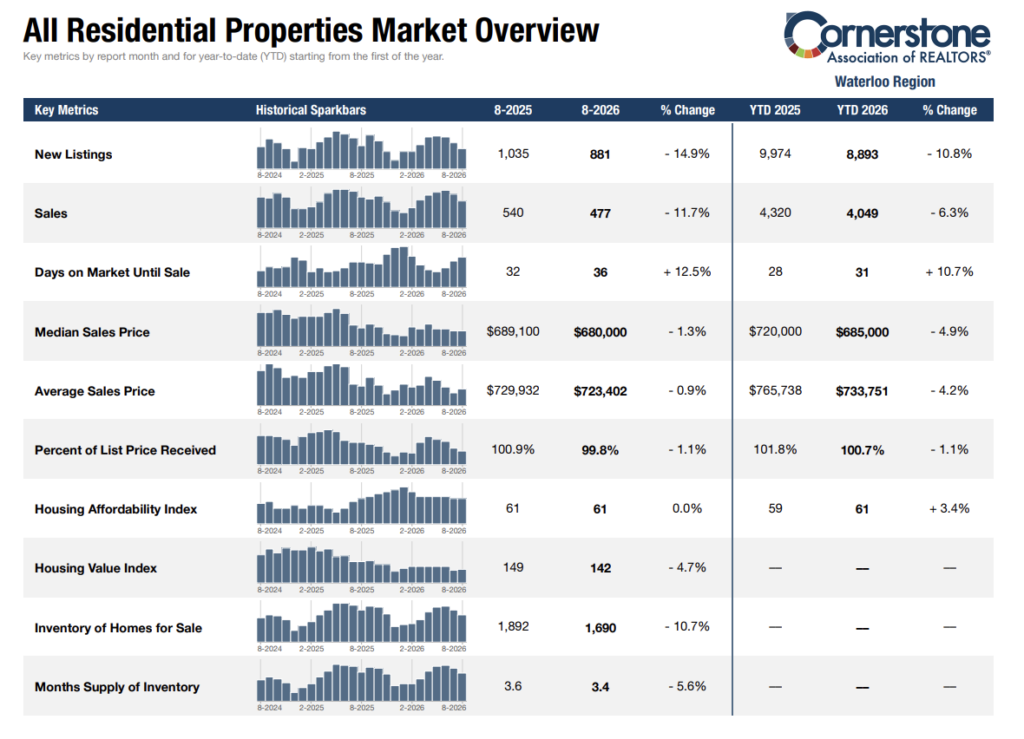
The Waterloo Region real estate market slowed in August 2026, with fewer home sales, fewer new listings and lower overall inventory compared with July.
Home prices, however, edged slightly higher month over month, while remaining below August 2025 levels.
For buyers and sellers across Kitchener, Waterloo and the surrounding Waterloo Region communities, the market continues to be active but increasingly selective. Buyers are paying close attention to value, and the way a home is prepared, priced and positioned continues to have a significant impact on the results sellers are achieving.
Here is a closer look at last month’s Waterloo Region real estate statistics and what they may mean as we move into the fall market.
Compared with July 2026 and August 2025:
Year to date, residential sales across Waterloo Region are down 6.3% compared with 2025. The average sale price is down 4.2%, while the median sale price is down 4.9%.
August saw a noticeable decline in sales activity, but supply also tightened. Fewer properties came to market and the total number of homes available for sale fell considerably. As a result, months of inventory declined despite homes taking slightly longer to sell.
The combination of slower sales and lower inventory is one reason broad market statistics need to be viewed carefully. Conditions can vary considerably depending on the type of property, location and price range.
Cornerstone Association of REALTORS®
The average sale price for a home in Waterloo Region was $723,402 in August 2026, up 2.3% from July but 0.9% below August 2025.
The median sale price reached $680,000, increasing 0.7% month over month while remaining 1.3% below last year.
Those relatively small year-over-year declines suggest that prices held up better than sales volume in August. However, the overall numbers mask a much larger difference between single-family homes and townhomes, semi-detached homes and condominiums.
The Waterloo Region housing market is becoming increasingly segmented. Single-family homes continue to show stronger relative demand, while townhomes, semi-detached homes and condominiums are generally offering buyers more choice and greater negotiating power.
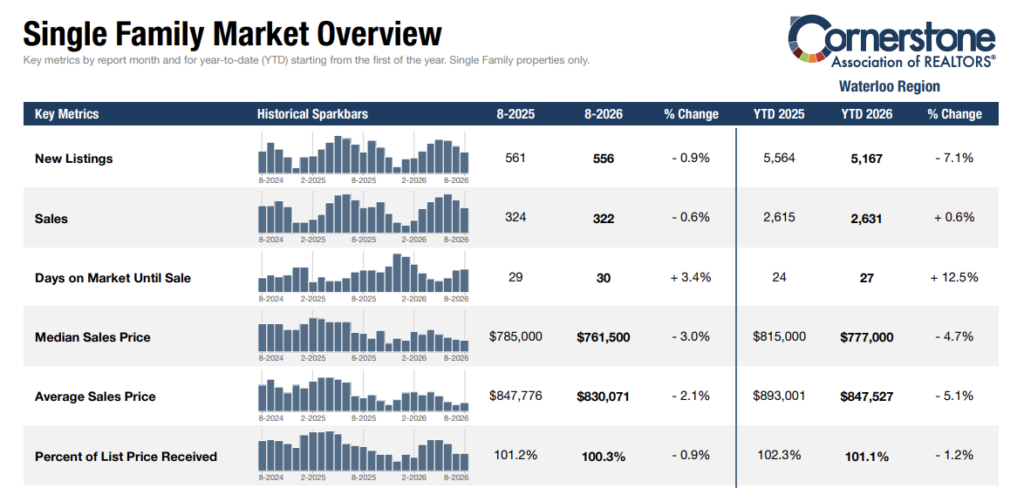
Single-family homes remained the more resilient segment of the Waterloo Region real estate market in August.
Year to date, single-family home sales are actually slightly ahead of 2025, increasing 0.6%. The average sale price is down 5.1% year to date, while the median price is down 4.7%.
With fewer than three months of inventory, relatively stable year-over-year sales and shorter selling timelines, single-family homes continue to show stronger demand than other segments of the Waterloo Region market.
That does not mean every detached home is selling quickly. Buyers remain price conscious, and properties that are not aligned with current market value can still sit for considerably longer. However, well-positioned single-family homes continue to attract attention and, in some cases, competition.
Cornerstone Association of REALTORS®
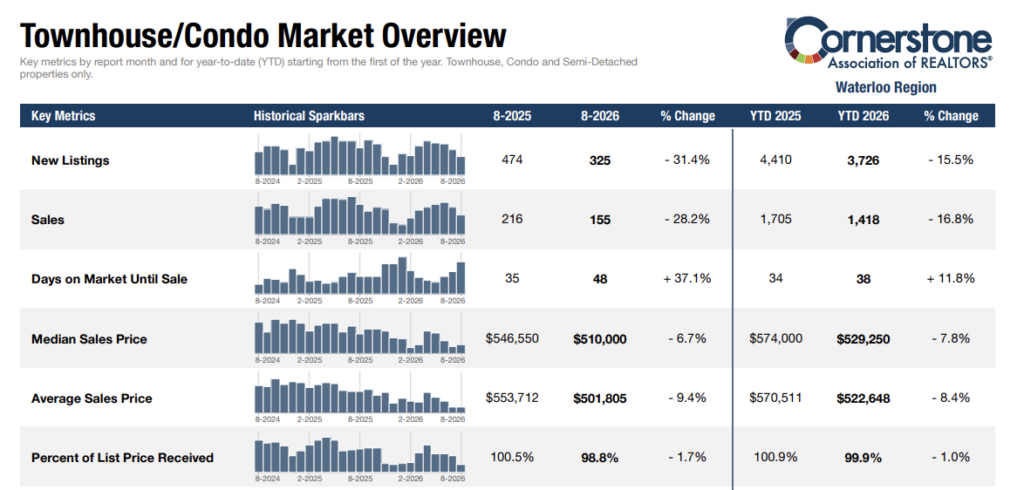
The townhouse, semi-detached and condominium market tells a different story.
Year to date, sales in this segment are down 16.8% compared with 2025. The average sale price is down 8.4%, while the median sale price is down 7.8%.
For buyers searching for a townhome, semi-detached home or condominium in Waterloo Region, this segment currently provides more selection and, in many cases, greater room to negotiate.
For sellers, it also means pricing needs to be especially precise. With longer selling timelines and more competition for each buyer, even relatively small differences in price, condition or presentation can have a significant effect on activity.
Cornerstone Association of REALTORS®
Homes are selling, but the margin for error on pricing has become very small.
One of the most important takeaways from the August 2026 Waterloo Region real estate market is how differently individual segments are performing.
Single-family sales declined only 0.6% from a year ago. Sales of townhomes, semi-detached homes and condominiums fell 28.2%.
That difference makes broad market averages considerably less useful when determining what a specific property may be worth.
Pricing a home in the current Kitchener-Waterloo real estate market often requires more analysis than reviewing a handful of recent comparable sales. We consider current competition, location, lot, square footage, condition, renovations, layout, inventory, buyer demand and pricing history.
When there are limited recent comparable sales, it may also be necessary to examine older transactions and historical market movements to determine how those properties translate into today’s market.
Not every comparable sale is equally relevant, and not every home should be prepared or marketed the same way.
When the analysis is thorough and a property is positioned correctly, we are still seeing buyers respond quickly and, in some situations, compete. When the price misses the market, even by what may seem like a relatively small amount, the difference in showing activity and buyer interest can be significant.
Preparation matters as well, but that does not mean every seller needs to spend heavily before listing. Part of an effective strategy is identifying which improvements are likely to influence buyer perception, which ones are unlikely to provide a meaningful return, and where a seller’s time and money can have the greatest impact.
Buyers generally have more time to assess a property than they did during the highly competitive markets of recent years, particularly within the townhouse and condominium segments.
More negotiating room does not necessarily mean buyers should expect large discounts on every property. Well-priced homes can still attract strong interest, especially within the single-family segment.
Instead, the current market makes property-specific analysis especially important.
Recent comparable sales, competing listings, days on market, previous price changes and the conditions within that particular neighbourhood and property type can all provide useful information when determining an appropriate offer.
The opportunity for buyers today is less about assuming every seller will negotiate and more about identifying where negotiating leverage actually exists.
Interest rates remain an important part of the Waterloo Region housing outlook.
On September 2, 2026, the Bank of Canada held its policy interest rate at 2.25%. The Bank noted that economic growth and inflation had evolved broadly in line with its previous forecast, while upside risks to inflation had increased and new tariffs had created additional uncertainty.
Future interest rate decisions remain dependent on incoming economic data.
RBC Economics expects Canada’s housing recovery to remain gradual and uneven rather than producing a sharp rebound.
Its latest outlook forecasts Ontario home resales increasing 8.2% in 2027, following a modest decline in 2026. Ontario home values are projected to increase approximately 0.7% in 2027.
RBC also believes interest rates may be near the low point of the current cycle. If that proves correct, future improvement in housing activity may depend increasingly on affordability, employment, consumer confidence and pent-up buyer demand rather than substantially lower borrowing costs.
These are Ontario-wide forecasts rather than Waterloo Region-specific predictions. Still, the broader message is relevant to the local market: any housing recovery is likely to be gradual, and performance may continue to vary considerably by property type, price range and location.
Statistics provide important context, but they do not always show what is happening with an individual home.
Across Kitchener, Waterloo and the surrounding communities, buyers are being selective. They are comparing properties closely and responding most strongly when the relationship between condition, location, presentation and price makes sense.
This is especially important in a market where different property types are producing very different results.
A detached home in a neighbourhood with limited inventory may face very different conditions from a condominium competing against several similar listings. Even two homes within the same neighbourhood can require different pricing strategies based on lot, layout, renovations, location within the neighbourhood and competing inventory.
For sellers, understanding the market around the property rather than relying solely on a regional average has become increasingly important.
As we move into the fall 2026 real estate market, Waterloo Region remains active but highly segmented.
Single-family homes continue to show stronger relative demand, with fewer than three months of inventory and sales levels that remain close to last year.
Townhomes, semi-detached homes and condominiums are experiencing softer demand, longer selling timelines and greater price sensitivity, providing buyers with more choice and negotiating power.
For sellers, accurate pricing, thoughtful preparation and strong positioning remain critical. For buyers, current conditions provide more opportunity to compare properties carefully and negotiate where the data supports it.
Broader forecasts suggest the housing market recovery is more likely to be gradual than dramatic. Locally, we expect the difference between property types, neighbourhoods and price ranges to remain particularly important.
Whether you are considering buying, selling, downsizing or relocating, understanding the market around your specific property is more valuable than relying on a regional headline.
If you would like an accurate assessment of what your home could sell for in today’s Kitchener-Waterloo real estate market, connect with The Deutschmann Team for a personalized home evaluation.
